Design firms, branding studios, and advertising agencies deliver ideas as artifacts. What they sell is thinking; what they deliver is a product: a brand system, a campaign, a concept. Before AI, the path from idea to product was long, expensive, and, most importantly, visible. Processes took time, skill, and teams of people; clients read that effort as evidence of the thought behind the product. Polish, thoroughness, artful articulation of the concepts, and hours stood in for the quality of the idea.
Other professional-services firms, such as those advising on strategy or operations, face a related but different problem. Their deliverable signals something other than originality: signal of a long relationship, a record of who was consulted and what work went into it, and a firm prepared to stand behind its recommendations. For these firms, too much originality can even signal risk, since clients may be wary of being first to deploy something untested. The collapse of effort as evidence reaches them as well, but in this case what is at stake is accountability, not originality.
AI radically changes the balance for creative firms. AI is superb at mechanics and process: assembling, drafting, rendering, and iterating. The cost of producing a first-rate, finished-looking product has collapsed, and with it the link between how an output looks and how good the idea behind it is. The result is a signaling collapse: the cues clients have long used to judge thought can now be produced without it. To the client, the product looks like creativity whether or not an original idea sits underneath.
This has happened before. Laser printers made any document look like a published work, and in the early days of the web, merely appearing online conferred authority. Audiences recalibrated thinking both times, and they will again. The open question is how long it takes, and what clients rely on in the meantime.
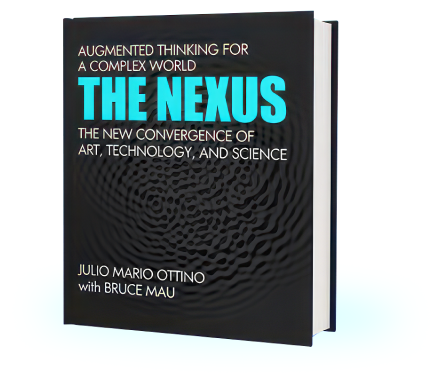
This does not mean that originality, the spark at the center of the concept, disappears. Thinkering, our term for design thinking plus making, is the reason. Bruce Mau and I argue that ideas emerge in the making, through sketching, iterating, and a conversation with the materials. Process is more than packaging; it is partly where originality gets shaped. But the looming presence of AI raises the stakes: automate the making, and we risk automating away the place where originality is born, and where practitioners, especially young ones, learn it.
What AI makes abundant is variation, and that abundance can deceive. Generated options tend to cluster around the probable; ideas rarely wander to the low-probability extremes where originality often lives. A thousand variations can still be a narrow set. What remains scarce is selection, framing, and taste: knowing which of a thousand options is worth pursuing, and which problem is worth solving. That is compass work, not map work, and it is where leadership comes into play.
Two futures emerge. In the first, sameness spreads, clients begin to notice that everything looks alike, and originality, hidden in the short run, becomes scarcer and more valuable. In the harsher version, clients cannot tell the difference, stop paying for originality, and its supply declines. Which one we get depends less on the technology than on whether clients, and the leaders of the firms that serve them, learn to see and price the idea, not just the glossy polish.
For firms, that means making the idea visible: showing the choices made, the options rejected, and the reasons, not only the finished output. One of the oldest ways to do this is also one of the simplest: rough sketches and early prototypes. Their roughness says “this is work in progress, your input is welcome,” which a polished deliverable cannot. It has to be real roughness, though. AI can render a convincing sketch as easily as a polished image, so what matters is that the client is genuinely part of the conversation.