AI may be the most powerful cognitive collaborator ever created. If used properly, it can stimulate ideas, surface connections, and open lines of exploration that would otherwise remain closed. It can act as a sparring partner – challenging assumptions, generating alternatives, stress-testing reasoning. Used this way, it extends what we can do.
But used differently, it can quietly do the opposite. When AI becomes a substitute for thinking rather than a companion to it, the risk is not bad output; the risk is intellectual dependency – the gradual erosion of the capacity that made the collaboration valuable in the first place.
The distinction is everything.
“AI expands thinking when it collaborates; it contracts thinking when it replaces.”
What follows are seven points – three reasons for genuine optimism, one that cuts both ways, and three things to watch carefully.
I. AI as Cognitive Collaborator
The gains are real and should not be understated. AI can compress months of synthesis into hours. It can hold more context simultaneously than any single human mind, retrieve content across domains no individual can master, and iterate at a pace that changes the texture of inquiry itself.
For researchers, writers, designers, and leaders, this is not a minor convenience. It is a change in the conditions under which thinking happens. Problems that once were stalled for lack of time or information can now move. Connections that would have required a fortunate accident of reading can now be found deliberately.
The key word is with. The collaborator model – human judgment directing, AI amplifying — produces something neither could reach alone. AI is only as good as the questions we ask.
“AI may be the most powerful cognitive collaborator ever created.”
II. AI as Universal Translator Across Domains
The best ideas live at intersections – between physics and art, between engineering and biology, between a centuries-old craft and a problem no one thought to connect it to. Origami and aerospace. Tensegrity and materials science. Cubism and quantum mechanics. The history of creativity is largely a history of unexpected adjacencies.
The obstacle has always been translation. Domains develop their own languages, assumptions, and blind spots. The physicist and the architect rarely share enough common ground to realize they may be working on the same problem from different directions.
AI changes this. Used properly it can stand fluently at multiple intersections simultaneously, recognizing structural resemblances across fields that specialists within each field would miss. It does not replace the human capacity for synthesis – but it removes a significant barrier to it.
“The best ideas live at intersections. AI can stand at all of them.”
III. Navigation Over Prediction
AI is advancing rapidly in prediction – forecasting demand, modeling outcomes, anticipating behavior. The gains are real. But prediction works best in stable, bounded systems, where the space of possibilities, while enormous, is bounded; where the future resembles the past and the rules stay fixed.
Many of the problems that matter most are not like that. Economies, organizations, geopolitical environments, and technological ecosystems are path-dependent and adaptive. They do not merely evolve in time – they evolve in structure. New actors emerge. New couplings form. The crucial variables are not simply unknown; they do not yet exist.
In such systems, the right question is not what will happen but what do we do next, given what just happened. This is navigation: iterative, feedback-driven, continuously revised. AI can support this navigation, but only if used as a partner. If used poorly it will offer false precision, confident answers to poorly framed questions.
“The challenge is not seeing farther ahead but knowing how to move when the landscape changes.”
IV. The Great Decoupling
The most successful coupling between science and technology is when prediction and understanding traveled together. To predict how a bridge would bear weight, you needed to understand the mechanics of materials. To forecast a weather system, you needed a model of atmospheric dynamics. Predictive power was a byproduct of explanatory power.
That coupling has broken.
For the first time, it is possible to predict accurately without understanding why the prediction works. AlphaFold determines protein structures with remarkable accuracy without operating from a mechanistic theory of how proteins fold. Large language models generate coherent outputs through statistical patterns whose inner logic resists clean inspection.
This is genuinely new in the history of knowledge – and it is neither simply good nor simply dangerous. It expands what we can do. But it also removes a check: the requirement that we understand something before we deploy it. A solution is no better than the assumptions embedded in it, and when those assumptions are invisible, the errors they introduce are invisible too.
“For the first time in history, we can predict without understanding. That is both the gift and the danger.”
V. The Hidden Cost: Agreement Arriving Too Soon
AI is extraordinarily good at synthesis. It absorbs competing positions, integrates data, and produces coherent recommendations that reconcile differences. What once required days of argument can now be resolved in minutes.
This looks like efficiency. It is often something else.
The most original ideas rarely emerge from smooth processes. They emerge from tension – competing interpretations held in suspension long enough to generate something neither side had anticipated. Large-scale studies of scientific and creative work consistently show that small, less-aligned teams produce more disruptive ideas. Larger, highly coordinated groups tend to refine what already exists. The difference is whether disagreement is sustained long enough to do its work.
When AI resolves disagreements too early – synthesizing before the tension has been productive – it shifts discussions and organizations from exploration to optimization. The output is coherent and defensible but, possibly only incremental. The underlying conflict never fully develops, and what emerges optimizes the present rather than challenging it.
If a conversation feels unusually smooth, ask not what was decided but what was never challenged.
“The danger is not disagreement. The danger is agreement arriving too soon.”
VI. Progression Without Progress
AI will accelerate science. More hypotheses will be tested, more data analyzed, more theories will be tested, more analytical result may emerge, and more publications will be produced. The pipeline will move faster. Volume will increase. But none of this should be confused with progress.
Science advances the way evolution does – through variation across many independent efforts, selection through critique and replication, and retention of results that hold up. The redundancy is not inefficiency. The failed experiments and divergent paths are not waste; they are data. They are the mechanism through which genuine novelty becomes possible and error gets exposed.
Optimization pressures work in the opposite direction. They drive convergence – faster iteration within a constrained search space – because the search space has been decided. The result can be more output and less discovery. Efficiency and novelty are different objectives, and they are sometimes in conflict.
The deepest advances in science are not combinations of existing knowledge. They are breaks-withs – conceptual ruptures that violate the assumptions embedded in everything that came before. These are precisely the results least likely to emerge from systems trained on the past and optimized for coherence.
“Optimization improves the route; discovery changes the destination.”
VII. A System Cannot Generate Its Own Transcendence
AI excels at recombination – mining the past, finding patterns, assembling existing elements into new configurations. This is genuinely valuable and should not be dismissed. Most innovation, after all, is combinatorial.
But the highest form of creativity is different. A breakthrough pierces the boundary of a domain and enlarges it. A break-with — rarer and more consequential — abandons the assumptions at the very center of prior thinking. Quantum mechanics did not extend classical physics; it violated its foundations. Cubism did not advance representational painting; it rejected the premise that painting should be representational.
Every piece of data that AI trains on contains the implicit assumptions that break-withs must abandon. The representational art that preceded Cubism, the classical mechanics that preceded quantum theory – these are not merely prior examples but embedded constraints. No analysis of the past, however exhaustive, could have generated what violated it.
This is not a critique of AI. It is a structural observation about any system operating from within a framework it cannot see around. Break-withs require stepping outside inherited logic. And no system – organizations and human institutions included – generates its own transcendence from the inside.
The implication is not pessimism. It is a clarification of roles. AI can explore vast possibility spaces from new starting points, once humans have asked the question that reframes the space. Asking that question – the one that violates current assumptions rather than extends them – remains irreducibly human.
“A system cannot generate its own transcendence.”
Closing: The Acceleration Trap
The future is arriving faster and faster. That much is not in doubt. What is in doubt is whether speed and progress are the same thing.
Karl Popper distinguished clocks from clouds. Clocks are complex but ultimately deterministic — their behavior can be specified, predicted, and optimized. A clock can be taken apart, understood, and reassembled. Clock thinking applies wherever problems have bounded solution spaces, repeatable procedures, and measurable outputs. Clouds are irreducibly different. They are shaped by contingency, sensitive to initial conditions, and resistant to any fixed description. A cloud cannot be taken apart without ceasing to be a cloud. Cloud thinking applies wherever judgment, navigation, and the capacity to act under genuine uncertainty matter more than optimization. Most of what we call complicated belongs to the clock world. Most of what we call genuinely uncertain belongs to the cloud world.
What accelerates is the clock world: synthesis, optimization, coordination, pattern recognition across vast domains. These are genuine gains. But the cloud world does not accelerate. Contingency remains stubbornly itself. The conditions under which a break-with becomes possible – oblique thinking, productive friction, sustained disagreement, the willingness to violate inherited assumptions – are not compressible. They resist clock formulations. And as the clock world speeds up, the gap between what can be accelerated and what cannot grows wider, not narrower.
What stays the same is deeper than it first appears. The structural logic of creativity remains intact. The three evolutionary logics – science accumulating, technology disrupting, art constantly reinventing – remain stubbornly distinct, regardless of the tools available to each. Contingency remains irreducible. The finest plans still lose to navigation; the insufficiency of the map, the centrality of the compass. Asymmetry that has always defined the most consequential advances persists: the break-withs did not come from the accelerating mainstream of their domains. They came from people working obliquely, at intersections, often against the grain of what everyone else was optimizing.
The same asymmetry that shapes creativity shapes work. Clock jobs — bounded, specifiable, optimizable — will be absorbed by AI not gradually but decisively. What remains, and what grows in value, are cloud jobs: work whose output is inseparable from contingency, relational judgment, and the capacity to navigate without a map. The question is not whether this displacement will happen but whether we are honest about which category most jobs actually fall into. Many that appear to require cloud thinking turn out, under pressure, to be clock work in disguise. AI will make that visible.
As optimization becomes more powerful, the pressure towards optimizing the mainstream intensifies. The search space gets explored faster – but it remains the same search space. Speed, in this sense, is not neutral. It narrows the conditions under which transcendence becomes possible.
Could transcendence happen? No analysis of the past, however exhaustive and however rapid, generates what must violate it. The data on which any system trains contains, embedded within it, the very assumptions that the next break-with must abandon. This is not a limitation that more computation could resolve.
And yet the history of ideas offers a different kind of consolation – not optimism exactly, but something more honest. Transcendence has never been predictable. It has always looked, from inside the prevailing framework, either impossible or unnecessary. What can be said is only this: it has happened before, always from the outside, always by someone willing to ask the question that the system could not ask of itself.
That capacity – to stand outside, to reframe, to ask the question that violates rather than extends – does not accelerate. It may, in fact, require deliberate cultivation of its opposite: slowness, resistance, the productive discomfort of ideas held in suspension long enough to do their work.
The worlds ahead will be built faster than any before. Whether they will be built differently depends on something speed cannot provide.
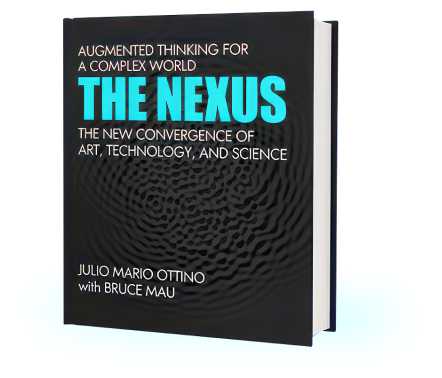
These points draw on work developed across several essays, papers, and the book The Nexus (MIT Press, 2022, with Bruce Mau).