Originally published in Leonardo, Vol. 59, No. 2, 2026.
Amid Conflict, a Need to Create Art
I grew up in Argentina with twin interests in the physical sciences and visual arts. I was lucky; my father worked in the sciences, and my mother had been trained in the arts. Understanding both sides helped pave the way for my career.
But before that could happen, the combination proved essential for navigating the sea of chaos that was Argentina in the late 1970s. The timelessness of math offered stability, while art gave me a cathartic means of expression.
Let me start on the science side. I ended up in engineering by default. The choices in those days were law, medicine, or engineering, and I was certainly not interested in law and even less so in medicine—childishly, since my father seemed to have a reverence for the medical profession. So, I started college in chemical engineering.
There, I had yearlong courses ending in oral exams—a remarkably inefficient system. One could accumulate courses and take finals years afterward, and while accumulating courses was relatively easy, passing the finals was far less so. Many people did not finish; some took ten or more years. But a yearlong course and a month or two of preparation for a final gave me a view of the material that could not possibly be acquired in a quarter-long course. This broad view of subjects has stayed with me.
But while I handled the rigors of engineering, chaos had begun to ensue in Argentina. Seven people would rule the country in the next seven years—nine if we count a junta. Four of those were army generals. I will list the names to capture the chaos of those years: President Gen. Juan Carlos Onganía was deposed; Roberto Marcelo Levingston, in turn, was deposed by a military junta led by Gen. Alejandro Agustín Lanusse. A brief democratic interlude occurred, and Héctor Cámpora served for three months as president, which enabled former president Juan Perón to return from exile in Madrid to become president, only to die after one year in office. His vice president, Isabel Perón, who was then his wife, succeeded him. Violence and economic crises reached new levels. After two years in office, she was deposed, and a three-man military junta—which included the commanders of the navy and air force—installed Lt. Gen. Jorge Videla, representing the army, as the president of the country.
The junta closed the National Congress, banned trade unions, imposed censorship, and brought state and municipal governments, including state universities, under military control. The military selected university presidents, and in some cases the presidents were themselves military officials. Under the banner of the “Process of National Reorganization,” later known as “the Process,” the worst atrocities of the “Dirty War” followed.
Intertwined with all this was a crisscrossing of armed organizations. These included the Montoneros, a left-wing, Peronist-leaning urban guerrilla organization that conducted kidnappings, assassinations, and bombings, and that supported Perón’s return but was later labeled a “subversive group” by the Peronist Party itself. Another such organization was the ERP (Revolutionary Army of the People), a Marxist guerrilla army linked to the Revolutionary Workers Party (PRT) that was active in both urban and rural areas, particularly in Tucumán, one of Argentina’s northern provinces. It also included the Argentine Anticommunist Alliance (AAA), supported by the Isabel Perón government itself, a right-wing paramilitary group that targeted left-wing activists, intellectuals, and guerrillas before the 1976 coup.
In addition to all this madness were the much-feared military and police death squads. After the 1976 coup, the military formalized repression through secret detention centers, where thousands were tortured and many disappeared; an estimated 30,000 people vanished at the hands of state forces. Those targeted included left-wing activists, students, educators, scholars in the social sciences and humanities, trade unionists, writers, journalists, artists, members of the clergy (especially those advocating liberation theology), alleged sympathizers of anti-regime elements and their families, and a disproportionate number of Jews. They were apprehended at night and taken to detention centers, where they were interrogated, often tortured, and killed. Many simply vanished.
At the time, my home represented calm—at least on the surface. My father had already experienced chaos, losing his position at the university when Juan Perón’s first government came to power. He had begun studying engineering but was forced to switch career paths—to veterinary medicine—after surgery left him convalescent and unable to afford an unplanned extra year of tuition. Eventually, he found his way to histology, which became his true calling, and for a time he ran an independent laboratory equipped with optical microscopes. Like him, I admired the beauty and craftsmanship of those instruments.
My mother, a college graduate as well, had studied fine arts at the College of Bellas Artes. I grew up surrounded by her small oil paintings, a very large charcoal drawing, and a few ceramics. She gave me her oils, palette, palette knife, and brushes. I still remember her art-school studies: translucent watercolor renderings of geometric solids and their shadows. As a child, I began drawing, and in my early teens I took up painting, producing about ten paintings a year. I even made sculptures. I was the type of person who was always creating something.
In my household, learning was deeply valued. It was taken for granted that one would earn an advanced degree. From my grandmother on my mother’s side, I saw books by Stefan Zweig, Curzio Malaparte, and Pearl Buck. My grandfather on my father’s side had a relatively large workshop—half devoted to woodwork, the other to metalwork. From him, I learned the value of precise craftsmanship.
So, while I studied engineering, art was always on my mind. During my first year at university, I spent a lot of time in coffeehouses—most of them with my girlfriend, Alicia Löffler, who later became my wife. We started dating when she was in high school; she was the youngest of five, with four older brothers. Her oldest brother was also a chemical engineer, and when he went to the U.S. for his PhD, she and her parents visited him. Not many people traveled abroad during those days, and I regarded Alicia as far more worldly than I was.
Part of my time in coffeehouses, I realized later, was spent honing my observation skills. I was mesmerized by how milk mixed with coffee. This became a ritual: using a spoon to create a gentle circular motion in the cup, then carefully pouring milk to watch the spirals form in the wake behind the spoon. Little did I know this would inspire my work on mixing and chaos. That work landed me, as a young professor, on the covers of Nature and Scientific American almost simultaneously. I had realized by then that understanding how regions can remain unmixed in a sea of chaos could inform mixing in oceans or why Jupiter’s red spot persisted.
While at the university, I became fascinated by the mathematical foundations of certain topics, especially the commonalities—the concept of finding unity in diversity. That idea of crossing domains has stayed with me to this day. A paid teaching assistant position opened; interviews and oral presentations followed, and, in what was a rare occurrence, I got a job without yet having obtained a degree. I became involved in experimental work and coauthored a technical paper.
The environment outside the university was chaotic, and the chaos would only increase. My last year at the university coincided with Lanusse stepping down. When I returned to the university in 1975, grades had been abolished; they were classist, we were told, and we were lectured on acquiring a political conscience. Worker strikes, weekly battles between police and students, and tear gas became a common occurrence. People were shot for walking on the wrong side of the street. Police stations were essentially cordoned off; one had to walk on the opposite side. We had a friend who was killed because of it. When I graduated, Perón was on his deathbed. That was when Perón’s third wife, Isabel, became president.
I started painting relentlessly during this time, whenever I could, in any media available to me. In my last year at the university, I created close to ninety works.
It is interesting to try to recall the influences from that time. They formed an eclectic list: Delacroix, Picasso, de Chirico (I discovered Piranesi later, in the U.S.), Brueghel, and Goya’s Disasters of War. I was fascinated by Kafka, Camus, Nietzsche, Dostoevsky, and Solzhenitsyn—also Chekhov, yes, but he was too peaceful. Like all educated Argentines, I was captivated by Sabato, a bit by Cortázar, and above all by Jorge Luis Borges—a fascination that continues to this day. Drawing and painting became a necessity. Dark colors dominated my palette. Figure 1 shows some of that work and its subsequent evolution.
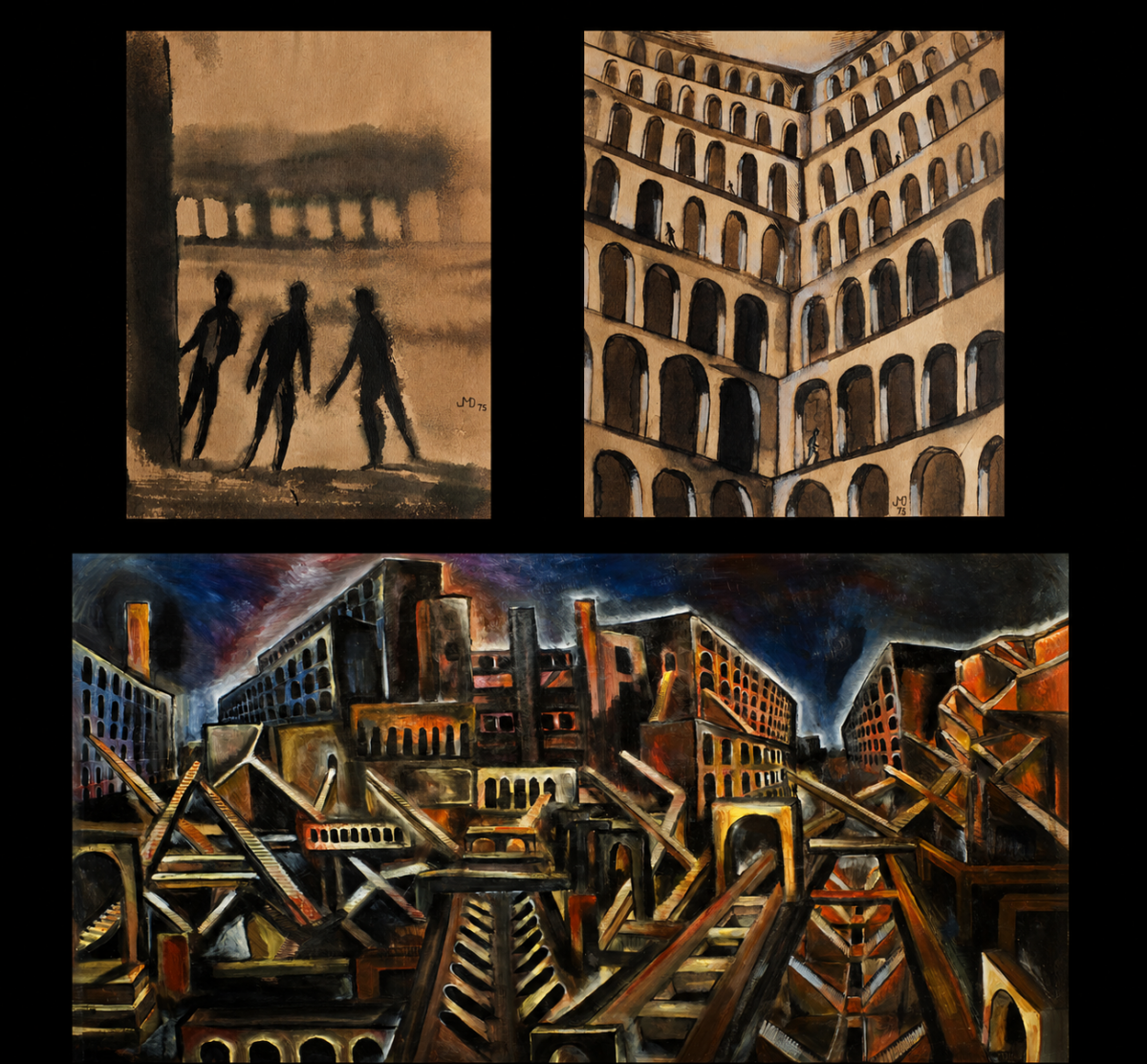
Homage to Ray Bradbury (1975), ink and watercolor, 5¾ × 7¾ in.; Process (1975), ballpoint pen and watercolor on paper, 6¾ × 8¾ in.; The Process 1 (1980), oil on wood panel, 27¼ × 41 in. © Julio M. Ottino
Did I try to rationalize what I was doing? No. It is easy to do that now—to romanticize the past—but it is clear what resonated with me in those days. I am unsure when I first encountered Tolstoy’s What Is Art?, where he writes, “Great men’s errors are to be venerated as more fruitful than little men’s truths.” Yes, that was me! I revisited this piece later, and I am not sure I would have agreed with him that art was anything that communicates emotion—I saw myself as a cool observer—but I think I would have agreed with his rejection of beauty as a defining element of art. How I wish I had known about Dmitri Shostakovich’s Symphony No. 7! The story of how it was composed while Leningrad was under siege by Nazi forces, and how the Leningrad premiere was performed by the surviving musicians, many suffering from starvation, would have been the kind of thing I would have deeply admired.
With the help of a distant but influential aunt, a nun, I managed to mount a solo art show at the Salón de Cultura Hispana, featuring fifteen paintings and three sculptures. Kafka’s The Process was a strong influence, and two of my paintings were titled The Process. Ironically, the Kafkian structure that gave rise to the “Dirty War” was also known as El Proceso—The Process.
A high point was when a critic visited, and I stayed to talk with him after the show had closed for the day. Another highlight of having the exhibition at the Salón de Cultura Hispana was discovering a complete collection of Ortega y Gasset’s Revista de Occidente. I longed to see anything that represented the world beyond Argentina. In those days, one could not browse freely through library stacks; one had to request specific books at a central desk. There was no possibility of serendipity.
It’s hard to imagine how I managed to fit in a two-week show amid the chaos and uncertainty surrounding us—especially since I had to complete my compulsory military service shortly after the show.
Creating Art During Military Training
Two years of compulsory military service were established in Argentina in 1901 to assimilate the massive immigrant population arriving in the early twentieth century. In 1970, a lottery system was introduced, and the terms of service changed: one year each in the army and air force, or two years in the navy. I drew the navy. At the time—in what may have been a brief experiment—the navy selected a group of graduates with clean political records who held degrees in engineering, architecture, law, economics, medicine, dentistry, and, as I recall, one solitary mathematician. After basic training, they were to be commissioned as officers. How I ended up in this group, I cannot say. Many were included through family or political connections. I had neither—only a clean record.
In fact, I nearly did not have a clean “political” record. Before joining this group, I had been to Bolivia with a Bolivian friend; it took three days to reach La Paz by land. It had been seven years since the execution of “Che” Guevara in Bolivia after being captured by forces aided by the CIA. Bolivia was regarded as a breeding ground for terrorists. I had a beard at the time, and I remember shaving before traveling. Good thing I did. We reached a lonely guard by canoe at the river at the frontier, where I had to show my passport, and behind him were hundreds of headshots of suspected terrorists. All had beards. I was surprised that this trip did not raise alarms.
After some initial training in Buenos Aires, our group traveled to the Bahía Blanca Naval Base, about 400 miles south of the city, for further instruction. I remember vividly that one of my classmates, whose last name was Jewish, was called aside and told he would not be joining us. We gathered at the train station in Buenos Aires—one hundred of us, all with short hair, unmistakably military. I wonder now what kind of security measures were in place; we would have made a desirable target.
Our days were filled with physical training and instruction, and I wrote nonstop at night. My letters to Alicia were full of existential drawings; she saved twenty of them. I am sure that the letters were monitored and opened. Why did I create the drawings? I never asked myself why; my letters simply would have been incomplete without them. Figure 2 shows some of the letters.
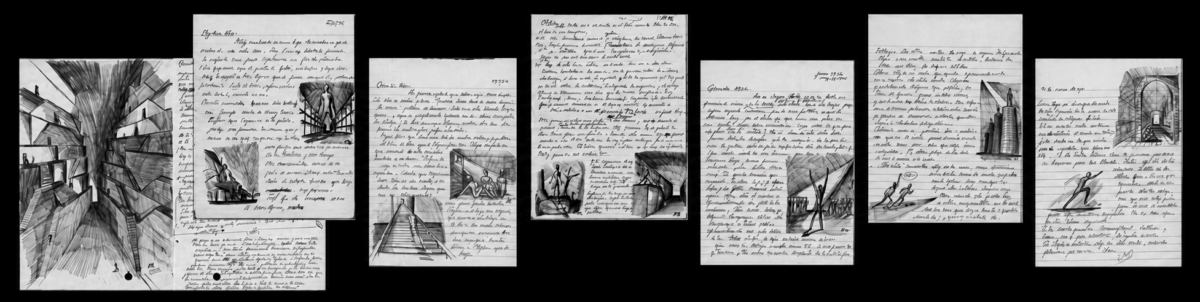
Correspondence during naval training. © Julio M. Ottino
I got into the best shape of my life. That is, until I ended up in the hospital after being severely dehydrated and with a possible case of hepatitis. After three days in bed and loads of intravenous plasma, the commanding officer of our group came to visit me. I had been drawing at the hospital; he looked at my drawings, and it was clear that he and I could not figure me out. “You are extremely idealistic,” he said. I spent a week there. It could have been worse: I would have had to stay twenty-five days if I had been diagnosed with hepatitis and would likely have lost my chance to become an officer.
Eventually, training was completed, and in a moment reminiscent of the film An Officer and a Gentleman, we became officers. I reported to navy headquarters in Buenos Aires and was immediately told to report to a ship that was leaving port in two days. The ship, the Punta Médanos, was an oil tanker. I learned that it had been the world’s fastest oil tanker when the navy acquired it, and that afterward it had taken part in the Falklands War before being sold for scrap two years later. Being assigned to an oil tanker turned out to be a lucky break—it had been a last-minute decision. The only available bunk was in the infirmary, where I stayed for about a week. Some of my friends were on destroyers and were only allowed one-minute showers.
We sailed close to the Malvinas (the Falkland Islands) and took part in joint maneuvers with the U.S. Being in complete darkness in the middle of the ocean, watching the moon set, was an unforgettable experience.
After a month at sea, I reported back to headquarters. I began working in a consulting office on maintenance issues, such as recommending whether a ship should go into dry dock or whether a propeller shaft needed to be machined or replaced. Only rumors reached me, but it was a far better assignment than those my friends who were doctors received. While they had to report to the shooting range, I would report to the language laboratory to learn and practice English. At that time, my German and my French were on par with my English.
It was a difficult and dangerous time. People continued to vanish left and right. Only twice—each time accompanied by a soldier—did I leave headquarters wearing my military uniform, once to inspect Argentina’s only submarine (a matter of replacing some piping). The work became routine. But in March 1976, we were told, “No one leaves tonight . . . at 2 a.m., we are taking over the government.” I was assigned to a group of marines and enlisted personnel. As we walked toward the truck that would take us to our destination—the main power plant of Buenos Aires—one of the enlisted men suddenly collapsed from a heart attack and died on the spot. Not a shot was fired, but I could write a book about our time there. We stayed about a week, and I was unable to communicate with my girlfriend, my family, or anyone. After that, I traveled the thirty miles between my home in La Plata and Buenos Aires carrying a gun.
Still, art—as ever—was always on my mind.
The Apollonian and the Dionysian
I have argued in previous writings on art and science that science is about making the unfamiliar familiar or the invisible visible. Art, especially modern and contemporary art, is the opposite: It is about seeing something we may have seen a hundred times before in a different light, a new viewing that makes the familiar unfamiliar—“perplexion,” or, as the Russian formalists called it, “estrangement.”
In writing about creativity and innovation, I have also argued that technology is about invention and science is about discovery, but that art need not be driven by purpose—at least not one that can be captured in a verb or a compact phrase. Objectives in art are as varied as artists themselves: to provoke, incite, irritate, challenge, reframe, shock, upset, document, nauseate, reflect, question, and reveal.
I suspect that little of what I did, according to the first definition, would count as art. And I wonder which verb I would have associated with the force behind my art in those times.
How I managed to operate amid chaos became clear only in retrospect. I had two identities: one inside the navy, the other outside. And the outside one was split into two. I did not know then of Nietzsche’s The Birth of Tragedy and his reference to the Apollonian and Dionysian dichotomy—reality as disordered and undifferentiated versus reality as ordered and differentiated. I lived in both: the pure, immutable, perfect Apollonian math world on the one hand, and the Dionysian world of Kafka’s The Process and Pieter Bruegel’s The Triumph of Death on the other. Only afterward did I see Borges as bridging both.
Alicia and I decided that we needed to leave the country. I applied to several universities for a PhD. I was accepted to the University of Minnesota, the same institution where Alicia’s brother had been, at that point the top place in chemical engineering in the U.S. Alicia had barely finished high school, but her family was happy that she was moving to a much safer environment. Her high school, an all-girls’ high school up until a couple of years before she attended, had been touched by the Dirty War, and several students—including young women—had disappeared. Others escaped Argentina and went to Europe. Two of her cousins had been abducted, never to be seen again, leaving a baby behind. We got married, got a visa, and ten days later we flew to the U.S.
In New York, we were met by Alicia’s oldest brother, Daniel, who was then doing a postdoc at Yale, and his wife. They were housesitting for a professor who was being pushed out of Yale. This professor, John Feen, joined Virginia Commonwealth University and later won the Nobel Prize in Chemistry.
In the U.S., I learned so much so quickly. I remember seeing the Yale library and the Louis Kahn addition, and Newton’s Principia proudly displayed. I owe a lot of my education to visits to museums. Upon arriving in Minneapolis, I saw Chuck Close’s paintings at the Walker Art Center and learned afterward that the Walker was the first major museum to acquire Close’s work. Many films had been banned in Argentina, including Last Tango in Paris, A Clockwork Orange, The Night Porter, Persona, Fellini’s Satyricon, and Teorema. We saw Last Tango in Paris in our first month in Minnesota.
We worked furiously. Alicia finished her BS degree in three years, and I earned my PhD in two years and nine months. We had considered moving to Europe, but I was offered a job at the University of Massachusetts Amherst. There, Alicia enrolled in a master’s program and then received her PhD. And it was there that I saw art and science as parts of a continuum, one enriching the other.
We kept an eye on Argentina. More government changes took place, and then the Falklands disaster happened. Another army general, Leopoldo Galtieri—memorialized in a Pink Floyd song—invaded the Malvinas. It was hard to tell what was real and what wasn’t; we heard a rumor that the government was calling up the reserves. We were not yet U.S. citizens. If I were called, it would mean either never being able to go back to Argentina or going back and possibly getting killed.
Ultimately, England reconquered the Falklands, and the Argentine military was discredited and deposed. Democracy was reinstated. Then we had what may have been, at least in part, the best years of our lives. It was unplanned, but we were perfectly synchronized. I took a visiting professorship at Caltech while Alicia did a postdoctoral fellowship there.
Art as an Indication of What Is to Come
It was much later that I thought again about my navy days; they had been buried in my subconscious. The first time was when I read the report of the National Commission on the Disappearance of Persons, a committee created by the democratically elected president Raúl Ricardo Alfonsín (whom we had a chance to speak with in Amherst) to investigate the fate of the desaparecidos. The report—known as Nunca Más (Never Again)—was headed by Ernesto Sabato. Although the report states that 8,960 people were documented as having disappeared during Argentina’s Dirty War, human rights organizations have estimated the actual number to be around 30,000. It was jarring to read a document that included details of torture in the library of our hometown, the bucolic village of Winnetka, Illinois.
The second time, in May 2024, was when I was invited to give the Michelson Memorial Lecture at the U.S. Naval Academy. Albert Michelson had been both a student and a professor at Annapolis and went on to become the first U.S. Nobel laureate in science. I spent two packed days in Annapolis and Washington, D.C. The uniforms of the U.S. Navy—and even some of its traditions—are identical to those of the Argentine Navy. Memories bubbled to the surface.
What is the purpose of art? Why do people create art in times of war and conflict? I am not sure my experiences provide any perspective not already explored. The reasons for creating art in such times are myriad: to document and bear witness; to imagine alternative visions to an oppressive reality; to process trauma and maintain mental health, and more. Thinking back, I created art during those chaotic times simply out of sheer inner necessity.
Creating art also conditioned me to pay attention to other places and to see the past more clearly. For example, art in totalitarian regimes—China, Russia, Nazi Germany—all seems to converge toward some form of socialist realism or realism.
All art represents its times. I cannot think of Abstract Expressionism without thinking of New York—de Kooning’s Excavation is one of my favorite paintings—or of Schiele and Klimt without thinking of Vienna. But some art captures the world yet to come. The raw emotional intensity and distorted perspectives of German Expressionism seem to foreshadow the chaos and trauma of the wars that followed. Artists like Beckmann—with his claustrophobic, angular scenes—and the anxious, fractured qualities in the works of Kirchner, Nolde, and Dix spoke to societal tensions before they fully erupted.
This forward-looking quality creates a more profound connection than purely aesthetic experiences, such as Monet’s serene water lilies. Paintings like those, while technically brilliant and emotionally soothing, exist in a different relationship to their historical moment—perhaps as refuge rather than prophecy.
To me, art in times of conflict may bear witness, but at its best, it presages what is to come.
Originally published in Leonardo, Vol. 59, No. 2, pp. 218–222, 2026. Published by The MIT Press.