Discover the world of nexus thinking
In this provocative and visually striking book, Julio Mario Ottino and Bruce Mau offer a guide for navigating the intersections of art, technology, and science.
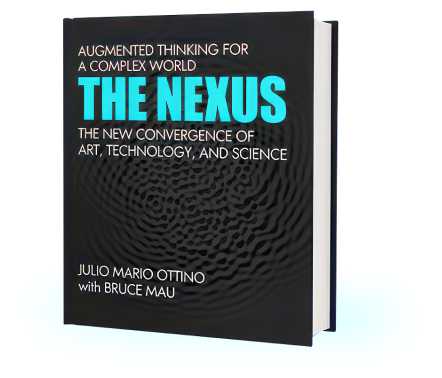


In this provocative and visually striking book, Julio Mario Ottino and Bruce Mau offer a guide for navigating the intersections of art, technology, and science.
Jorge Luis Borges was born in Buenos Aires in 1899. He never wrote a line of code and never saw a computer. Yet he may be the best guide we have to the technology of this decade and to the Zeitgeist of today’s world.
In 1941 he published “The Library of Babel”, a short story of a library containing every possible book – every combination of letters and punctuation. Somewhere on its shelves sit the true history of the future, the lost scrolls of Alexandria, the Magna Carta. But the Library is almost entirely gibberish. For every meaningful page there are countless near-duplicates, subtle corruptions, plausible falsehoods. The librarians wandering its hexagonal rooms are not short of text; they are drowning in it. What they lack is not books but judgment, a way of telling the true catalog from the infinite false ones.
It is hard to read it today without recognizing our situation. A large language model is a compressed map of Babel: a vast combinatorial space of possible text, with probability concentrated on the regions that sound right. The astonishment of the past four years is that sounding right turns out to be achievable. Borges’s warning is that sounding right was never the scarce resource. The Library always contained every eloquent answer. What it could not contain was the head librarian, the one who could identify the true books.
Borges saw the other half of the problem. In “Funes the Memorious,” published a year later, a young man in nearby Uruguay acquires, after a horse accident, perfect total recall. Funes could remember the shape of every cloud he had ever seen; reconstructing a day took him an entire day. And yet he could not grasp the concept of a cloud; no two were ever the same. Total memory without abstraction is not thinking; perfect recall is not intelligence. Neither is infinite text.
A third story, also from 1941: in “The Garden of Forking Paths,” time forks perpetually – every moment carries the futures that might have been. History looks inevitable only in reverse; read forward, it is a garden of paths not taken. So it is with technologies, including this one. Nothing about AI’s present shape was foreordained; nothing about its future is either. Its aura of inevitability is a trick of retrospection, the same trick Borges spent a life exposing.
The two stories seem to collide. If the Library contains every possible book, it contains every possible future – every fork of the garden already transcribed. Borges felt the vertigo: “La certidumbre de que todo está escrito nos anula y nos afantasma” – the certainty that everything is written annuls us, turns us into phantoms, he said in “The Library of Babel”. But I one looks closely and the collision dissolves. The Library holds the true history of the future and, shelved beside it, unmarked, the infinite false ones. Everything is written, but nothing is chosen. A catalog of every possible path says nothing about which path is being walked. Contingency does not vanish into the Library; it becomes illegible there. The forking is not in the text but in the walking. And the phantom-anxiety inverts: if every book already exists, then writing was never about the making of sentences. It was about the taking of a path – selecting this book from its infinite corrupt siblings. Authorship is selection.
Generation is now abundant. Selection is not. Knowing which question to ask, which answer to trust, which of the plausible books is the true one – it is work the Library cannot do for itself. It requires standing outside the shelves.
The next advantage will not go to those with access to the Library; everyone has access now. It will go to those librarians who bring questions, taste, judgment, and a feel for the forking paths.
Borges died in 1986, a decade before the web and forty years before the machines that now write. Somewhere in the Library of Babel this essay already exists – beside every version of it that will never be written. The Library did not choose this one. I did.