An editorial I co-authored with Brian Uzzi just appeared in Science.
The piece examines a question that is rapidly moving from speculative to urgent:
What happens when AI systems move from assisting science to conducting science?
Recent advances make it increasingly plausible to envision automated “end-to-end science” systems: integrated pipelines capable of generating hypotheses, running experiments, analyzing results, and producing publishable outputs with minimal human intervention.
The issue is not whether AI can do science. Increasingly, it can.
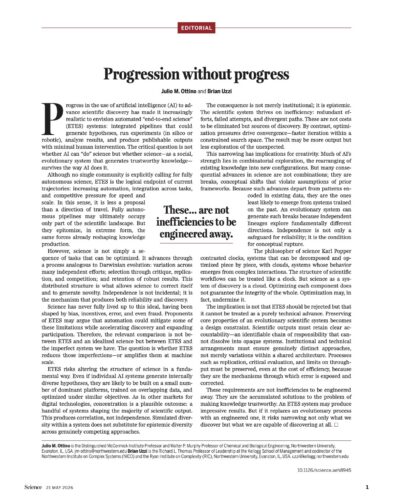
The deeper question is whether science—as an evolutionary system for generating trustworthy knowledge—survives the way AI does it.
Science progresses not simply through optimization, but through variation, independence, critique, replication, failure, and competing approaches. In many ways, it behaves less like a machine and more like an evolving ecosystem.
That distributed structure is often inefficient. But those inefficiencies are precisely what generate robustness, creativity, and genuine novelty. One of the paradoxes explored in the editorial is that efforts to optimize and increase efficiency can inadvertently destroy the very properties one is trying to improve. In complex evolutionary systems, redundancy, friction, and competing pathways are not defects to be engineered away; they are conditions for resilience and breakthrough discovery.
A central concern is that highly integrated AI-driven scientific systems, especially if concentrated around a small number of dominant platforms, could increase correlation across scientific outputs while reducing true epistemic diversity. The danger is not only institutional concentration, but conceptual narrowing.
Optimization can accelerate exploration within existing frameworks. But many transformative scientific advances emerge precisely by breaking from prevailing assumptions.
As we argue in the editorial, preserving independence, accountability, replication, and genuinely distinct approaches may become essential design constraints—not obstacles to efficiency.
The future challenge may not be simply building more powerful systems for science, but ensuring that in optimizing discovery we do not unintentionally narrow what humanity is capable of discovering.
This editorial originally appeared in Science on May 21.
Download a PDF of the article.