Two pieces, one argument. Our Science editorial in May made the structural case against end-to-end automated science. Now, in American Scientist, Brian Uzzi and I tell the human components behind it.
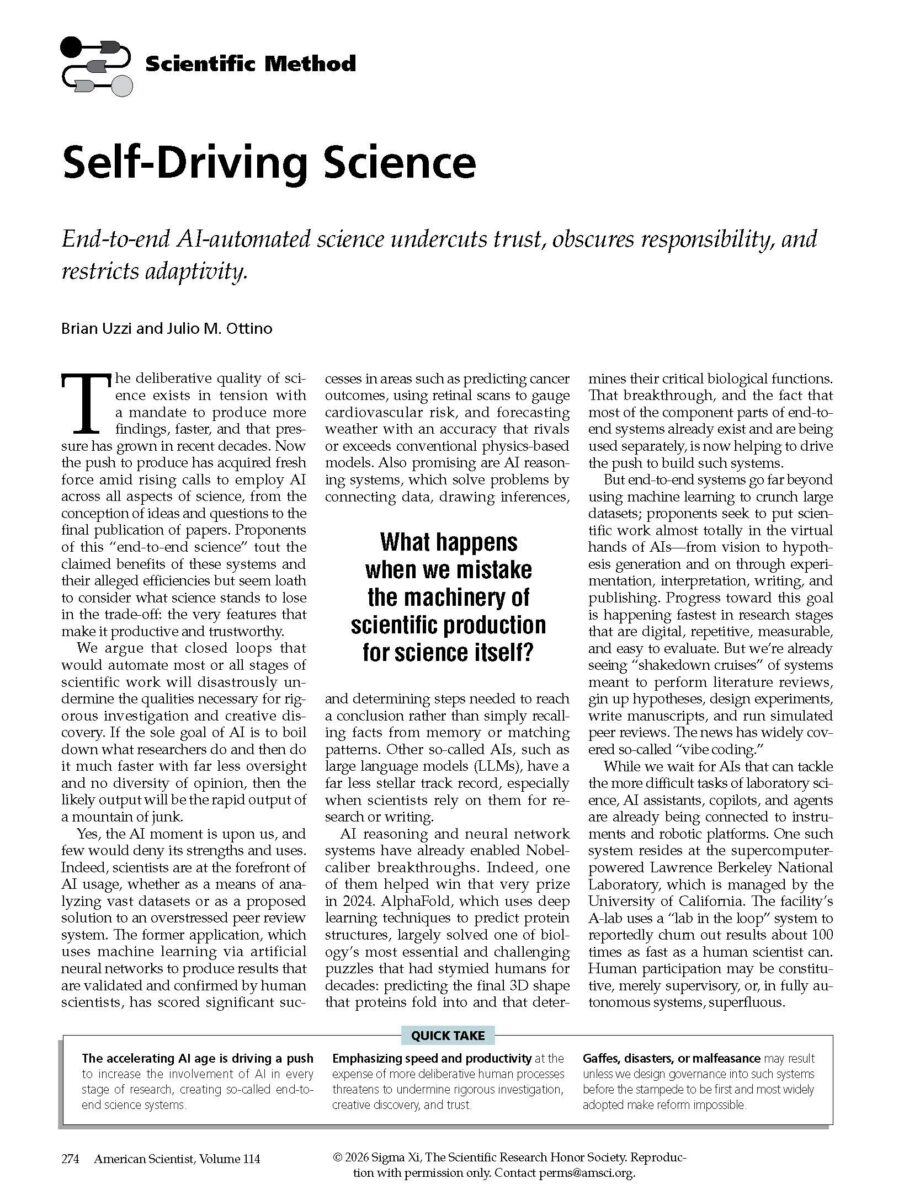
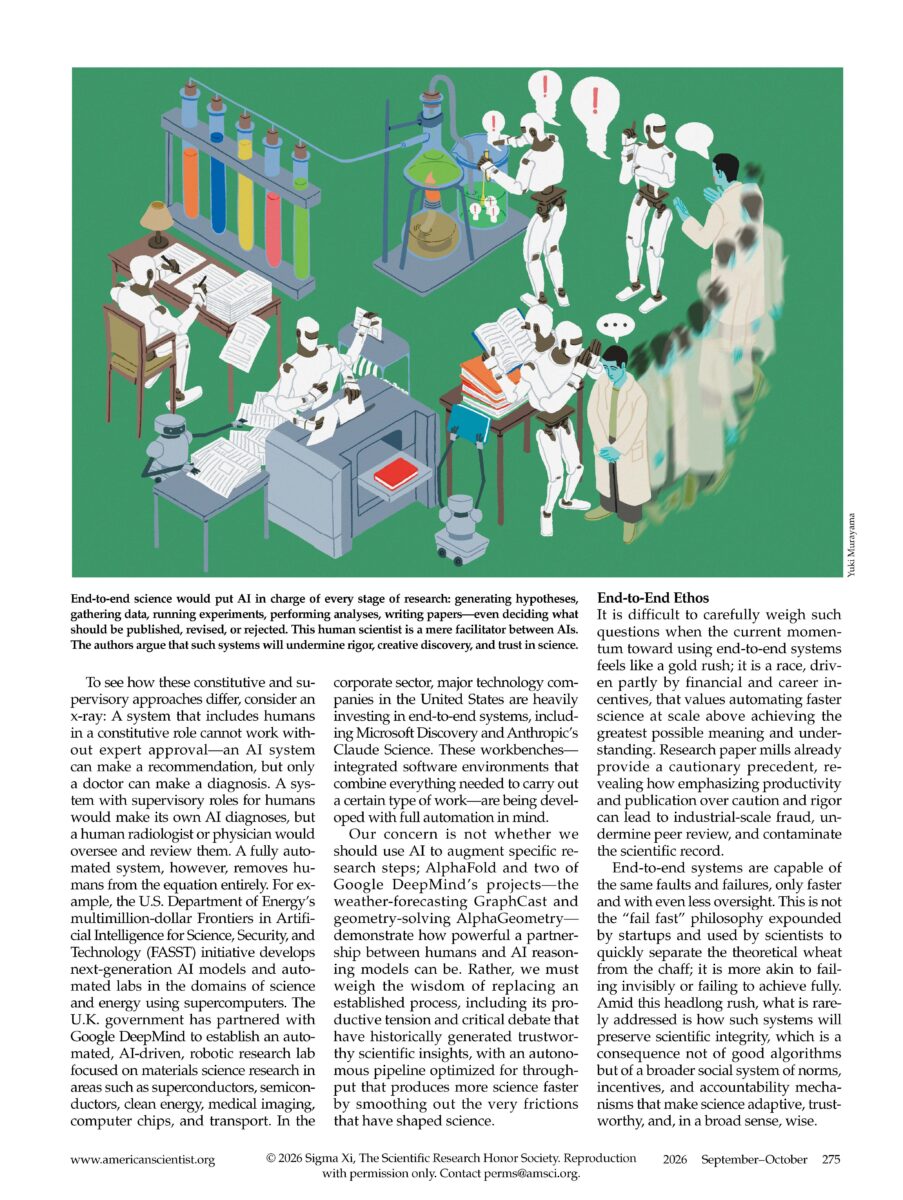
“Self-Driving Science” examines the push toward AI pipelines that generate hypotheses, run experiments, write papers, and even referee them. Proponents promise speed. What they rarely address is what gets traded away.
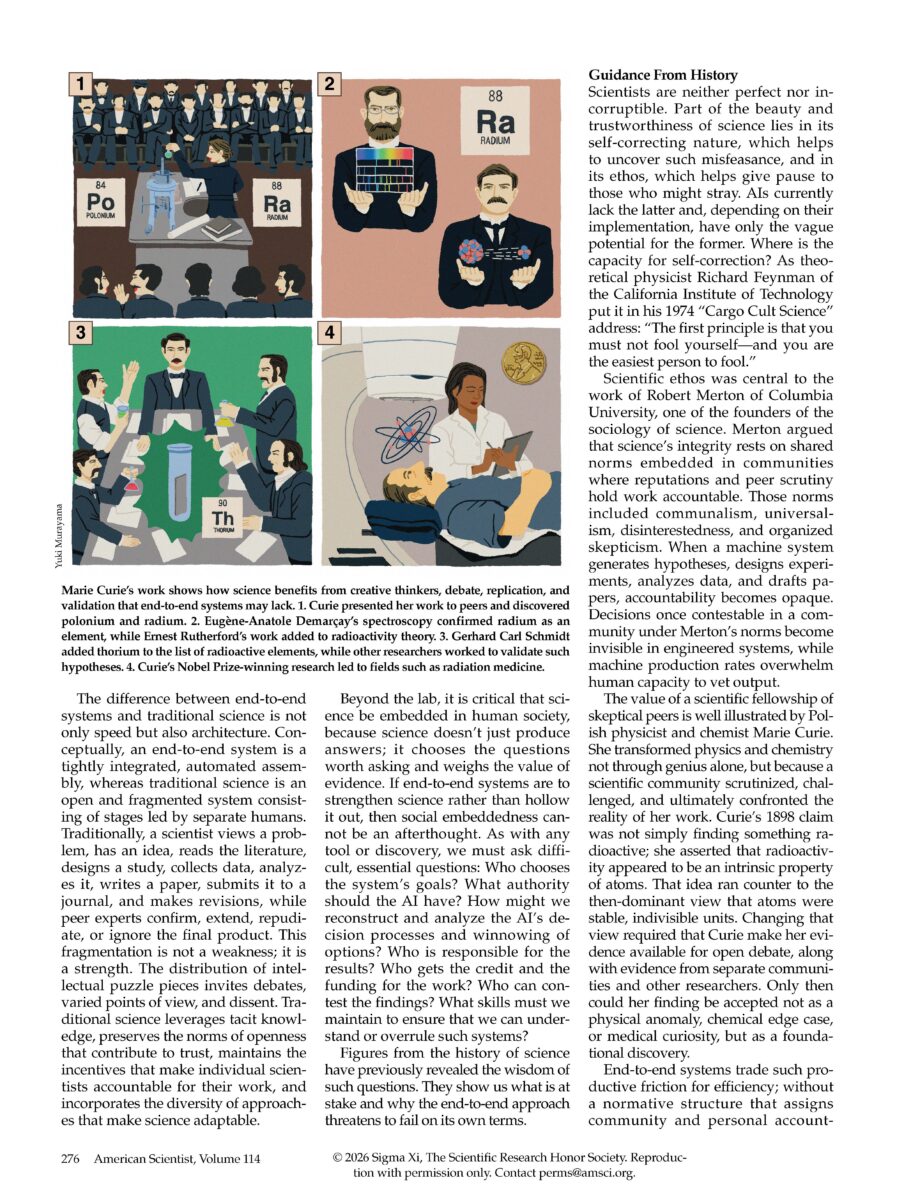
Our argument: the frictions of science are precisely what make it work. Debate, replication, dissent, the scrutiny of skeptical peers – these look like inefficiencies awaiting optimization. They are the accumulated checkpoints that test and transform ideas and make knowledge trustworthy.
History makes the case. Curie’s radioactivity claim became foundational only because a community contested and confirmed it. Planck’s reluctant break with classical physics shows that resistance is the essence of discovery itself. And Oppenheimer’s “Now I am become Death” reveals something end-to-end systems dissolve: a human “I” who bears the moral weight of the work.
Evolution succeeds through variation – independent lineages exploring different directions. Optimization destroys variation. A monoculture is efficient right up until it isn’t.
The question is whether we are wise enough to build these systems in ways that preserve the foundational structures that made science successful. Otherwise, we are replacing science with something that resembles it, and hoping the resemblance holds.
Read the full American Scientist article below.