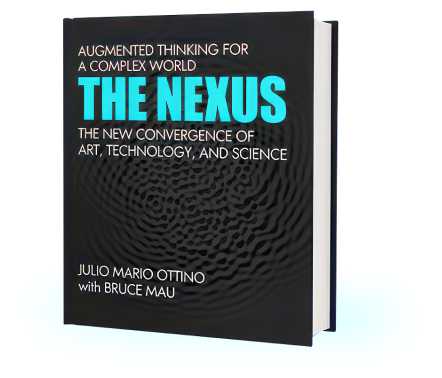
In this talk, I reflect on the central theme of The Nexus: how the Newtonian worldview shaped not only science, but also organizations, leadership, and the way we think.
For more than three centuries, we lived in what I call a “clockwork” world. It was a world built on prediction, precision, determinism, and control. That mindset enabled extraordinary achievements, from the Enlightenment to the Industrial Revolution and beyond. But today, we inhabit a very different landscape. Ours is a world of networks, feedback loops, interdependence, and emergence. Most of what matters now—economies, institutions, societies—behaves less like a clock and more like a cloud.
In the talk, I revisit the great scientific revolutions that followed Newton—thermodynamics, relativity, quantum mechanics, evolution, computation—and distill the lessons they offer. These revolutions did not replace Newton; they expanded our understanding. They introduced probability, irreversibility, interconnectedness, and the power of the many. They revealed that uncertainty is not a flaw in our knowledge, but a feature of reality.
I also explore the role of artificial intelligence. AI is astonishing in its reach. It can mine vast domains, connect ideas, and generate answers. But it remains bounded by the assumptions embedded in its data. True “break-with” creativity—the kind that reframes a domain—still depends on human curiosity and the ability to ask questions that others do not even see as questions.
Ultimately, this talk is about mindset. It is about augmenting the clockmaker’s precision with the cloud watcher’s awareness. The organization of the future must embrace uncertainty at the micro level while maintaining coherence at the macro level. It must synthesize contradictory viewpoints, draw strength from multiple perspectives, and create conditions for emergent creativity.
We do not need to abandon the Newtonian worldview. We need to transcend it.