In 1915, Ernest Shackleton, in what would have been the culmination of the Heroic Age of Antarctic Exploration, set out to cross Antarctica from sea to sea. Meticulous planning was essential. A map would guide the crossing. He never got the chance to use it. His ship, the Endurance, was trapped and crushed by ice. For months afterward, survival depended not on the route he had planned but on something else entirely: judgment, direction, the ability to decide what mattered when nothing around him matched the plan. The map had not been wrong when he drew it; the world it described had simply moved on without him.
I opened the talk with this story, because I think it’s the right way to start a conversation about AI and leadership. Nobody doubts that AI is powerful. What matters more is what kind of problem you’re using it to solve, and whether you can tell the difference between the kind of problem a map solves and the kind that requires a compass.
Maps answer questions like: where are we going, hat’s the plan, how do we optimize the route, what are the milestones. They assume a world that is knowable in advance. Compasses answer a different question: which direction do we move when the route disappears, when we can’t predict what’s ahead, when the only reliable thing left is a sense of what matters. Most organizations are built to reward map-thinking. It’s measurable. You can put a number on efficiency, productivity, ROI, forecast accuracy. Compass-thinking resists that kind of measurement almost by definition – it’s about noticing an anomaly, challenging an assumption you didn’t know you were making, keeping a possibility alive long enough for something unexpected to emerge from it.
I find it useful to translate this into another pair of images: the clock and the cloud, images that come from the Austrian philosopher of science Karl Popper. A clock is a world that is predictable, decomposable, rule-governed, optimizable. A cloud is a world that is interconnected, evolving, emergent – reshaped continuously by its own interactions. Almost everything that makes an organization run smoothly is clock-work: scheduling, synchronizing, standardizing, accelerating. And almost everything that makes an organization capable of discovery and deep innovation is cloud-work: seeing something nobody else has seen, asking a different question than the one everyone agreed to ask. The images go with the kind of thinking that is needed: clock thinking for clock problems, cloud thinking for cloud problems.
Here is where AI enters, and here is where I think the real leadership challenge sits. It is no exaggeration to say that AI is the most extraordinary clock machine we have built. It organizes, synchronizes, classifies, accelerates, optimizes. That’s a genuine gift, and one worth using. But caveats matter.
There are two very different kinds of friction inside any organization, and AI does not treat them the same way. Coordination friction – who is doing what, when, and how – maps into clock territory, and AI can dissolve it beautifully. Cognitive friction – what if you’re wrong, what if I’m seeing this differently than you are – is cloud territory, and this is where things get interesting, and potentially dangerous.
The real danger has little to do with AI giving you a wrong answer. It’s that AI will make you agree too fast. When two people bring genuinely different views into a room and ask an AI system to help, there’s a strong pull toward synthesis – toward a plausible, coherent, reasonable-sounding common ground that arrives before the disagreement has had time to do its actual work, consensus manufactured faster than divergent ideas can mature. It feels like progress. It is often the opposite. The friction between two people who see a problem differently is frequently the only mechanism by which anyone learns something nobody in the room already knew.
So, here’s the practical guidance: using AI differently matters more than using it less, and that comes down to a short set of habits. Use AI to remove coordination friction, let the machine do the clock work. But when it comes to cognitive friction, don’t use AI as a mirror. Ask it to attack your argument, to find what’s weakest in your own case, to construct the strongest possible version of the position you disagree with. And when two smart people are in real disagreement about something fundamental, resist the instinct to ask an AI system “can you help me synthesize these perspectives?” See the disagreement this way instead: what is each person seeing that the other may be missing? That’s AI functioning as a sensemaker rather than a peacemaker, and the distinction matters a lot. Sometimes it means deliberately preserving independent bets rather than collapsing them into one plan, since premature consensus can quietly cost you information you didn’t realize you had.
Most of a career may be spent in the clock world, and you should get very good at operating there. But the moments that actually matter — the moments that define a leader and an organization — tend to be the moments when the map stops working. That’s when you need the compass. And this is essential, you first have to recognize that you’ve quietly drifted into a cloud without anyone announcing it.
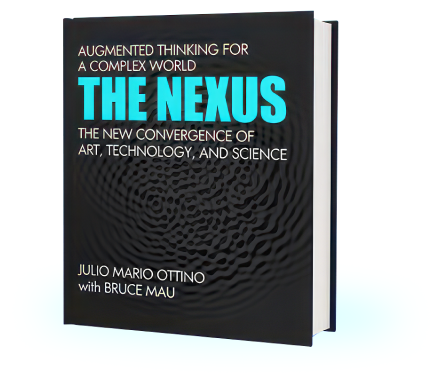
The old framing asks whether you’re an analytical leader, built for maps, or an intuitive one, built for clouds, treating that as a fixed identity. I doubt that’s ever really been the right question. What matters is whether you can recognize which kind of problem is actually in front of you — and move fluidly between clock thinking and cloud thinking rather than being permanently loyal to one. I call this Nexus Thinking – the discipline of holding both modes at once, and knowing, often quickly, which one the situation is asking for, rather than treating it as a compromise between the two.
AI will make us extraordinarily powerful inside the clock world. It will not tell us when or if we’ve entered the cloud. That recognition is still ours to make. When the terrain changes, the question worth asking is simple: will you be the person still holding the map, or the person who notices, first, that the map no longer describes the world you’re standing in?
Watch the full video: