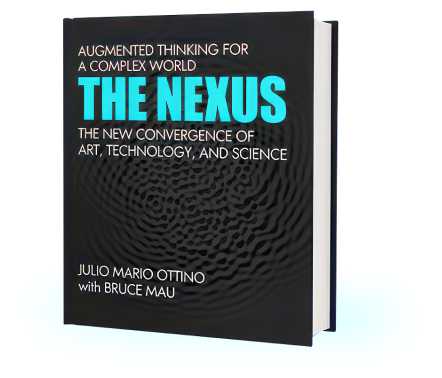
Gary Saul Morson and Julio M. Ottino
“Traveler, there is no road. The road is made by walking.”
—Antonio Machado
Machado’s famous line suggests that the future does not exist in advance, waiting to be discovered, but comes into being through a choice among possible actions. Many possibilities exist at any given moment. The one that becomes actual depends on coincidences and chances as well as choices, all producing events whose significance emerges only as they unfold.
That, as it happens, is also Leo Tolstoy’s argument in War and Peace. In the book’s battle scenes, plans dissolve into confusion, causes multiply beyond reckoning, and outcomes hinge on fleeting, unrepeatable moments. On the eve of the Battle of Borodino, the novel’s hero, Prince Andrei, reflects that what lies ahead is not a determinate sequence but “a hundred million chances…decided on the instant.” What matters is less the perfection of a plan and more the ability to respond to what no plan could anticipate, by means of what Tolstoy calls “alertness.”
For Tolstoy, this is a feature not of war alone but of reality in general. History, far from representing the execution of a grand design, is rather the result of countless interacting elements, each shaping and reshaping what can happen next. New possibilities are always emerging as earlier ones are left unrealized. Life more closely resembles an evolving system than a solved equation. Events are contingent in Aristotle’s sense of the term: They “can either be or not be.” After all, if things could only happen one way, human action would collapse into the mechanical execution of what was already implicit in the present. “If human life could be [entirely] governed by reason,” Tolstoy writes in the book’s epilogue, “the possibility of life is destroyed.”
And yet again and again, in our aspiration to a hard science allowing for prediction, we are drawn to deny this. That is one reason War and Peace has never lost its relevance.
The Recurring Dream of Certainty
Since the scientific revolution, Western thought has repeatedly returned to the hope that contingency might be an illusion. As Newton explained the baffling complexities of planetary motion by four simple laws, perhaps, many imagined, the same could be done for human affairs. Thinkers as diverse as Marx, Skinner, and Malinowski have shared this dream, with each promising, in his own way, to reveal necessity beneath apparent disorder.
Complexity, for such men, is conceived of as a surface phenomenon, concealing an underlying simplicity that, once uncovered, will render the future knowable. Pierre-Simon Laplace insisted that events are certain, not probable: In speaking of their probability, we are really speaking of the chances our guesses may be accurate, but the events themselves are certain. Time and again, the apparent contingency of events is presented as evidence of our own ignorance. If we knew enough, we would see that events could not have happened otherwise.
But there is another possibility: that contingency is real—that the world is not merely complicated but fundamentally generative, that new possibilities are not simply revealed over time but produced within it, through the interaction of elements that cannot be fully anticipated in advance.
This is the world Tolstoy describes, one where knowledge cannot precede action, only emerge through it.
Time and the Limits of Foresight
Tolstoy’s deepest insight concerns time itself. In a deterministic view, time is a neutral space where events unfold according to fixed laws and the future lies already implicit in the present, waiting to be revealed. But in Tolstoy’s world, time is generative. Each moment reshapes what can happen next. Possibilities interact, combine, and disappear, their significance becoming visible only as events unfold.
One might say that the system is constantly generating variation—new configurations, new alignments, new opportunities—but without any overarching mechanism that selects among them in advance. Selection happens locally, in real time, through action. The closer one looks, the more things fail to simplify, as in the Newtonian model, and ramify instead. What happens to be taken up is what persists.
This is why most Austrian and Russian generals in War and Peace are consistently wrong. They believe they possess a science of warfare—a system capable of anticipating outcomes. Before Austerlitz, they insist that “every contingency has been foreseen.” The result is Napoleon’s greatest victory—yet their confidence remains intact, attributing failure to imperfect execution, never to the limits of prediction itself. As so often happens, the conviction that events must conform to a science makes the supposed science unfalsifiable.
The wisest general, Kutuzov, appreciates that people conceive only of a few possibilities while there are thousands. Famously, in the Council of War before Austerlitz, he advises not more planning but “a good night’s sleep.” What matters most is the alertness to seize opportunities that cannot be anticipated in advance.
This distinction—between a world that can be mapped and one that must be navigated—extends beyond warfare. Wherever outcomes depend on unfolding interactions, local knowledge, and irreversible time, no complete science is possible. One can orient oneself, but one cannot blaze the path in advance.
The Illusion of Inevitability
If the future is open, why does the past so often appear inevitable? Tolstoy offers several answers, including what he calls “the law of retrospection.”
Once events have occurred, we can reconstruct the paths that led to them. We identify signs that seem to foreshadow the outcome we now know. Alternatives fade from view—not because they were not real, but because they left no trace. The result is a powerful illusion: What happened begins to seem as if it had to happen.
Tolstoy asks us to imagine a group of men hauling a log, all pulling in different directions. Wherever they happen to wind up, someone will say they planned to do so.
This retrospective projection—which one of us has called backshadowing—reshapes our understanding of history. We look at earlier moments and conclude that the outcome was implicit all along. The more coherent the explanation, the easier it is to forget that things might have turned out otherwise. To avoid backshadowing, we must practice sideshadowing—recognizing that other outcomes, some of which we can imagine, were genuinely possible.
That is just the insight that those who believe they have discovered a hard science allowing for prediction in the social world forget or deny. And yet they cannot foresee their own future.
Tolstoy’s narrative resists this illusion by preserving the density of lived experience—the sense that at each moment multiple futures were genuinely possible. History, in this view, is not a line but a branching structure, most of whose branches vanish without record.
AI and Narrative Certainty
In the age of AI, this dream of certainty has taken a new and more persuasive form. Artificial intelligence can process vast datasets, identify patterns invisible to human perception, and generate explanations with remarkable coherence. Faced with such capabilities, it is tempting to believe that uncertainty can finally be overcome—that the future can be rendered legible in advance.
But the deeper effect of AI lies in its ability to reorganize the past. Given sufficient data, AI systems can produce narratives that make outcomes appear coherent, even inevitable. They can identify correlations, reconstruct causal chains, and highlight what they regard as signs foreshadowing what followed. The result is not necessarily false, but it is selective.
In this way, AI functions less as a predictor than as a powerful engine of narrative compression, reducing the apparent space of possibilities by presenting a single path as the path. What was once understood as a field of possible alternatives becomes retrospectively legible as an inevitable sequence, reducing many “futuribles” to one. The danger here lies in premature coherence, the sense that complexity has been resolved when it has only been reorganized into a persuasive form.
A Compass Rather Than a Map
Tools do more than extend thought; they reshape the environment in which thought occurs. AI, for instance, introduces a distinctive bias by generating what is statistically coherent, what resembles patterns derived from accumulated data.
In an evolutionary system, what persists is not necessarily what is best in any absolute sense but what is most easily selected under prevailing conditions. AI changes those conditions in the intellectual world, lowering the cost of generating variations while subtly guiding selection toward what is already legible within its patterns.
Over time, this can narrow the space of perceived possibilities by making them less visible, less accessible, less likely to be pursued. Certain forms of thought—those that resist simplification, that depend on sustained attention, or that emerge from direct engagement with the world—become comparatively fragile.
What follows from Tolstoy’s ideas, on the other hand, is not that prediction is useless or that analysis should be abandoned, but rather that we must think in terms of a compass rather than a map. A map assumes a fixed terrain and a determinate path, while a compass provides direction without specifying the route. In a world of genuine contingency, only the latter is available. One can choose a bearing, but the path itself is discovered through movement. Orientation is not foresight.
This is the force of Machado’s insight: The road is made by walking not because we lack information but because the path does not exist until it is created.
To accept this is to adopt a different understanding of knowledge, not as a complete representation of what will happen, but as a capacity to respond intelligently to what does happen. It is inseparable from time, from attention, from the ability to recognize significance as it emerges.
The impulse to eliminate contingency is understandable. Uncertainty is uncomfortable: It resists control and frustrates planning. But it is also what makes agency possible.
A world in which everything could be predicted would be a world in which nothing could be otherwise. Action would lose its meaning, since outcomes would already be fixed. The openness of the future is not a defect in our knowledge, but a condition of human life.
Artificial intelligence does not change this condition—but it can make us forget it. By rendering the past as if it had been inevitable, it invites us to imagine that the future is already written. Against this, one must insist on what Tolstoy and Machado understood in saying that the future remains unwritten, not because we have failed to compute it but because it does not yet exist.
Article originally published in the The Hedgehog Review.